Open-Type vs Fully Enclosed Fiber Laser Cutting Machine: Which Should You Choose?
When buying a fiber laser cutting machine, one of the first decisions is machine structure. Many buyers compare open-type machines and fully enclosed machines, but the right choice depends on budget, production volume, safety requirements, factory environment, and automation needs.
An open-type machine may be suitable for entry-level users and small workshops. A fully enclosed machine is usually better for continuous production, safer operation, and a cleaner workshop environment.
This article compares both structures in a practical way.
1. What Is an Open-Type Fiber Laser Cutting Machine?
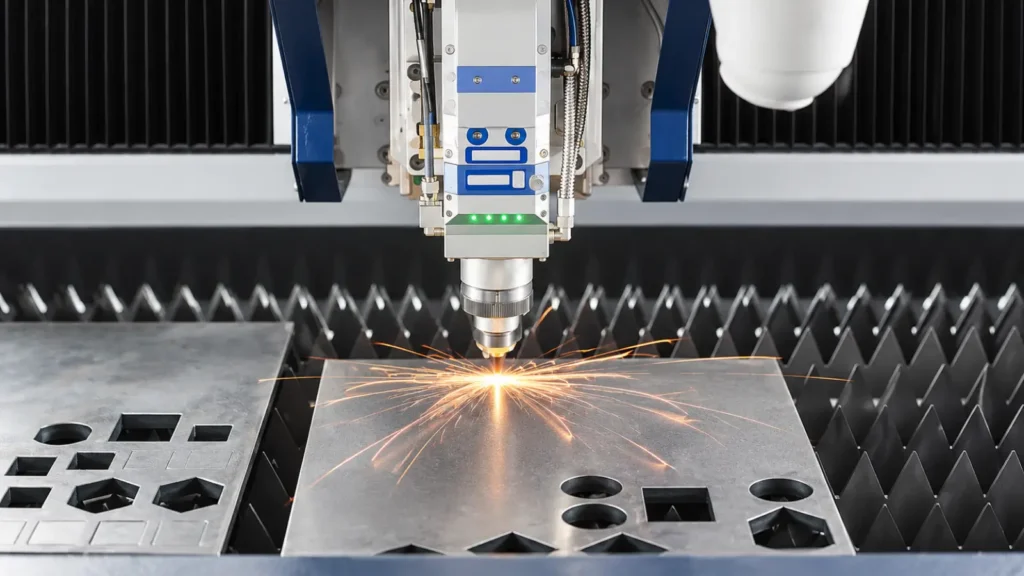
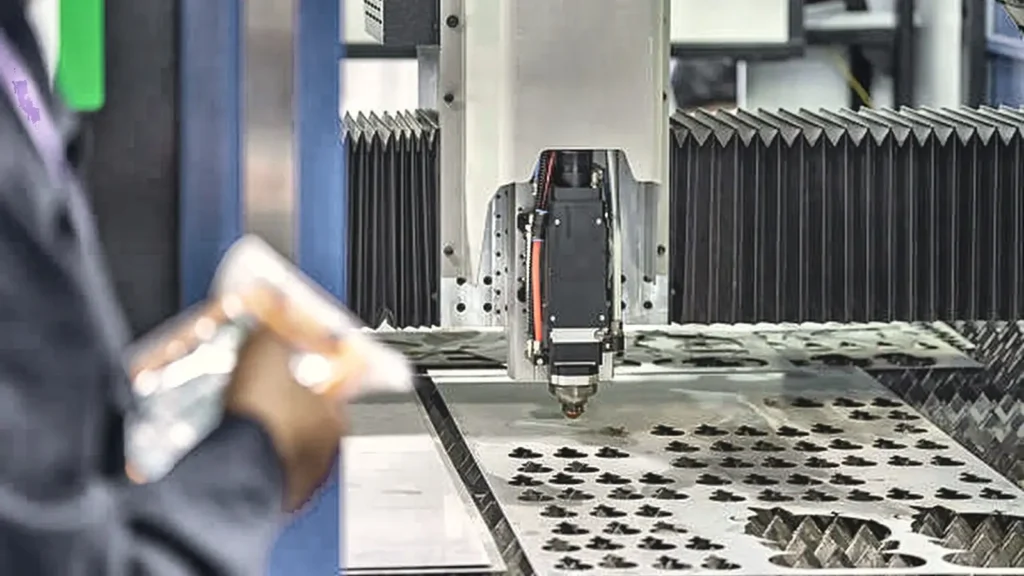
An open-type fiber laser cutting machine usually has a single worktable and an open cutting area. The operator can load and unload sheets directly from the front or side of the machine.
This structure is simple and practical for many small and medium workshops.
Common features include:
- Single cutting table
- Open machine structure
- Manual loading and unloading
- Lower purchase cost
- Smaller floor space
- Easier access to the cutting area
- Simple maintenance access
Open-type machines are often used by companies that are buying laser cutting equipment for the first time or mainly process thin and medium-thin metal sheets.
They are common in small sheet metal shops, advertising metal products, custom fabrication, small hardware production, and low-to-medium volume metal cutting.
2. Advantages of Open-Type Machines
The main advantage of an open-type machine is lower initial investment. Because the machine does not include a full enclosure or exchange table system, the purchase cost is usually lower.
This makes it attractive for buyers with limited budgets.
Open-type machines also provide easy material access. Operators can load sheets manually, remove parts quickly, and inspect the cutting process directly.
Other advantages include:
- Lower equipment price
- Simple structure
- Easy manual operation
- Convenient loading and unloading
- Lower floor space requirement
- Suitable for small batches
- Suitable for flexible job shop work
- Easier access for basic maintenance
For users who mainly cut thin sheets and do not run continuous high-volume production, an open-type machine can be a practical starting point.
3. Limitations of Open-Type Machines
Open-type machines also have clear limitations.
Because the cutting area is not fully enclosed, protection against laser radiation, smoke, sparks, and fumes is weaker than a fully enclosed machine. This does not mean open machines cannot be used, but it means the factory must pay more attention to safety management, operator training, protective measures, and ventilation.
The main limitations include:
- Weaker enclosure protection
- More exposure to smoke and sparks
- Less suitable for high-power cutting
- Less suitable for continuous batch production
- Manual loading and unloading may limit productivity
- Workshop environment may be harder to control
- Not ideal for factories with strict safety requirements
Open-type machines should not be promoted as equal to fully enclosed machines in safety and environmental control.
If your factory plans to run long shifts, cut coated materials, process high-power thick plates, or upgrade to automation, a fully enclosed structure may be more suitable.
4. What Is a Fully Enclosed Fiber Laser Cutting Machine?
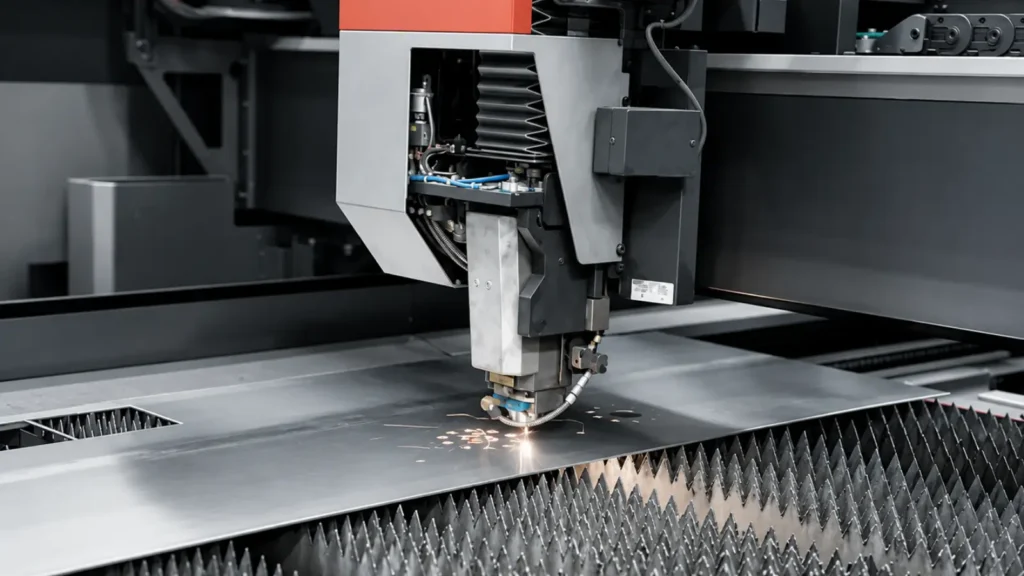
A fully enclosed fiber laser cutting machine uses a protective cover around the cutting area. It often includes a laser protection viewing window, safety door interlock, sectional dust extraction, and an exchange table system.
The enclosure helps reduce operator exposure to laser radiation, smoke, sparks, and cutting debris.
A fully enclosed machine is often used in medium and large sheet metal factories, machinery manufacturing, electrical cabinet production, automotive parts, elevator components, kitchen equipment, and metal processing centers.
Common features include:
- Full protective cover
- Laser protection window
- Safety door interlock
- Dual exchange worktables
- Sectional dust extraction
- Automatic focusing cutting head
- Better smoke control
- Compatibility with automatic loading systems
- Better workflow for batch production
A fully enclosed fiber laser cutting machine is usually a stronger choice for companies that care about production continuity, safety, and long-term factory planning.
5. Advantages of Fully Enclosed Machines
The first major advantage is safety. A full enclosure helps separate the cutting process from the operator area. Safety doors, interlocks, laser protection windows, and emergency stop systems can reduce operational risk when correctly designed and used.
The second advantage is workshop environment. Laser cutting produces fumes, dust, sparks, and slag. A fully enclosed machine with sectional dust extraction can collect smoke more effectively than a basic open structure.
The third advantage is production efficiency. Many fully enclosed machines use an exchange table. While one sheet is being cut inside the machine, another sheet can be loaded or unloaded outside the cutting area. This reduces waiting time.
Other advantages include:
- Better operator protection
- Better smoke and spark control
- Higher efficiency with exchange table
- More suitable for high-power laser cutting
- Better compatibility with automation
- More professional factory image
- Easier integration with loading and unloading systems
- Better support for continuous batch production
For manufacturers that need stable daily output, the fully enclosed structure usually provides stronger long-term value.
6. Limitations of Fully Enclosed Machines
Fully enclosed machines are not perfect for every buyer.
The main limitation is higher initial cost. The enclosure, exchange table, safety system, dust extraction design, and larger machine structure increase the machine price.
They also require more factory space than many open-type models. The exchange table needs additional room for sheet loading and unloading. Installation and transportation may also be more complex.
Potential limitations include:
- Higher purchase price
- Larger floor space requirement
- More complex structure
- Higher installation requirements
- More components to maintain
- Not always necessary for very low-volume production
If a small workshop only cuts thin sheet occasionally, a fully enclosed exchange table machine may be more than necessary.
However, for factories planning long-term growth, better safety, and higher production efficiency, the extra investment may be reasonable.
7. Production Efficiency Comparison
Open-type machines usually rely on manual loading and unloading. When one sheet is finished, the operator removes parts, clears waste, loads the next sheet, and starts cutting again. During this time, the laser is not cutting.
Fully enclosed exchange table machines reduce this non-cutting time. One table cuts inside the enclosure while the other table is available for loading and unloading.
This structure is especially useful for:
- Batch production
- Medium and large sheet sizes
- High-power laser cutting
- Multi-shift operation
- Factories with stable order volume
- Companies planning automation
However, the exchange table only improves loading efficiency. It does not automatically solve all production bottlenecks. Part sorting, material storage, gas supply, dust extraction, and downstream bending or welding must also be considered.
8. Safety and Environmental Comparison
Safety is one of the clearest differences between the two structures.
An open machine needs stricter operator discipline and external safety measures. The operator must understand laser hazards, smoke control, spark risks, and machine operation rules.
A fully enclosed machine provides stronger built-in protection. A well-designed fully enclosed machine may include:
- Full protective cover
- Safety door interlock
- Laser protection window
- Emergency stop buttons
- Door-open laser protection
- Sectional dust extraction
- Low gas pressure alarm
- Cooling water alarm
- Electrical protection
This does not mean a fully enclosed machine needs no safety management. Operators still need training, maintenance procedures, and protective rules. But the machine structure provides a stronger safety foundation.
For companies cutting galvanized steel, coated metals, stainless steel, and high-volume sheet metal parts, dust extraction and enclosure design should be taken seriously.
9. Automation Potential
Open-type machines are usually more limited in automation upgrades. Some may support basic loading assistance, but they are not always ideal for full production-line integration.
Fully enclosed exchange table machines are more suitable for automation. They can often work with:
- Automatic loading systems
- Automatic unloading systems
- Sheet storage towers
- Automatic nozzle changers
- Nozzle cleaning systems
- Robot sorting
- MES or ERP production management
For high-power systems, automation becomes more important because cutting speed increases. Without automation, manual loading and unloading can become the main bottleneck.
If your company plans to expand production in the next few years, it is better to consider automation compatibility before purchasing the machine.
10. Which Machine Should You Choose?
Choose an open-type fiber laser cutting machine if:
- Your budget is limited
- You are buying your first laser cutting machine
- You mainly cut thin or medium-thin sheets
- Your production volume is not very high
- Manual loading and unloading are acceptable
- Factory safety and ventilation can be properly managed
- You need a simple and flexible machine
Choose a fully enclosed fiber laser cutting machine if:
- You need better safety protection
- You run batch production
- You want higher loading efficiency
- You use medium or high laser power
- You cut coated or smoke-producing materials regularly
- You need better workshop environment control
- You plan to add automatic loading or unloading
- You want a more professional long-term production system
The right choice depends on your production stage and business plan.
Conclusion
Open-type and fully enclosed fiber laser cutting machines serve different needs.
An open-type machine is more affordable, simple, and suitable for small workshops or entry-level users. A fully enclosed machine costs more, but it provides better safety protection, better smoke control, higher loading efficiency, and stronger automation potential.
If your company mainly cuts thin sheets in small batches, an open-type machine may be enough. If you need continuous production, better safety, higher efficiency, and future automation, a fully enclosed exchange table machine is usually the better choice.
The final decision should be based on materials, thickness range, working hours, production volume, budget, safety requirements, and long-term factory planning.